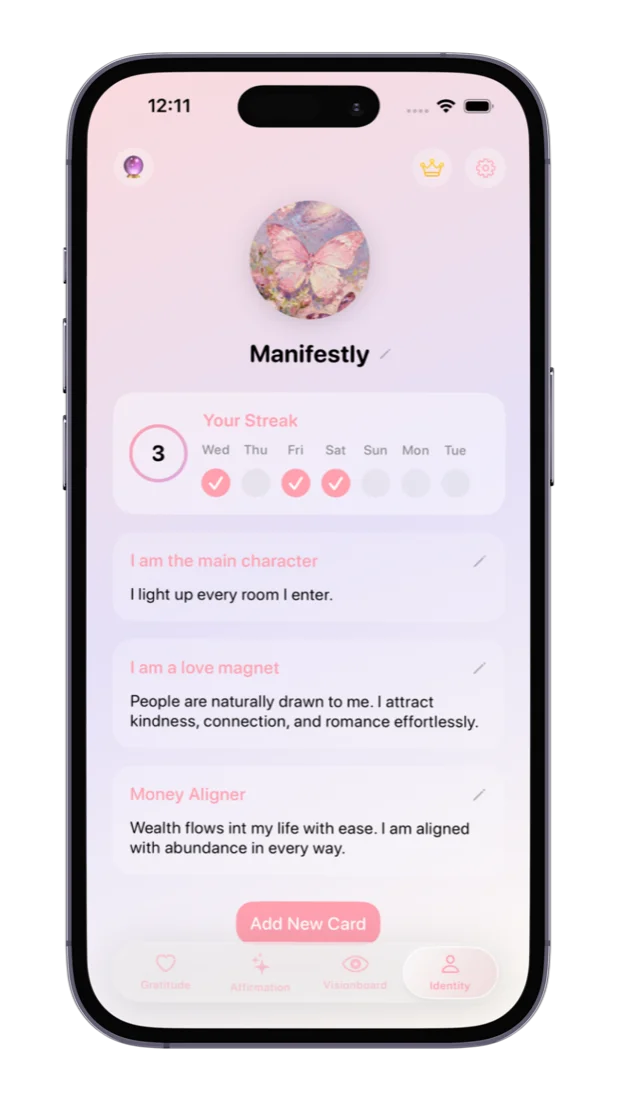
I am the main character
“I light up every room I enter.”
A reminder to take up space, trust your presence, and participate fully in the life that belongs to you.
Use these as inspiration, then choose words that feel true to the person you are ready to embody. Your identity should sound like you, not like someone else’s definition of success.
“I light up every room I enter.”
A reminder to take up space, trust your presence, and participate fully in the life that belongs to you.
“People are naturally drawn to me. I attract kindness, connection and romance effortlessly.”
Define how love feels around you and who you are within it, rather than tying your identity to one specific person.
“Wealth flows into my life with ease. I am aligned with abundance in every way.”
Use a role name if it helps you step into a new relationship with money — calm, capable, open, and aligned with abundance.
“Calmly, and without needing anyone to watch.”
Name the pattern you are choosing now. Every finished task becomes evidence that this identity is already taking root.
“Stopping early is a skill, not a failure of nerve.”
Your best self is not only productive. This card makes rest part of the identity you are proud to live from.
“What I have to say is worth the air it takes.”
Read it before a meeting, conversation, or moment when you want to show up with confidence and clarity.
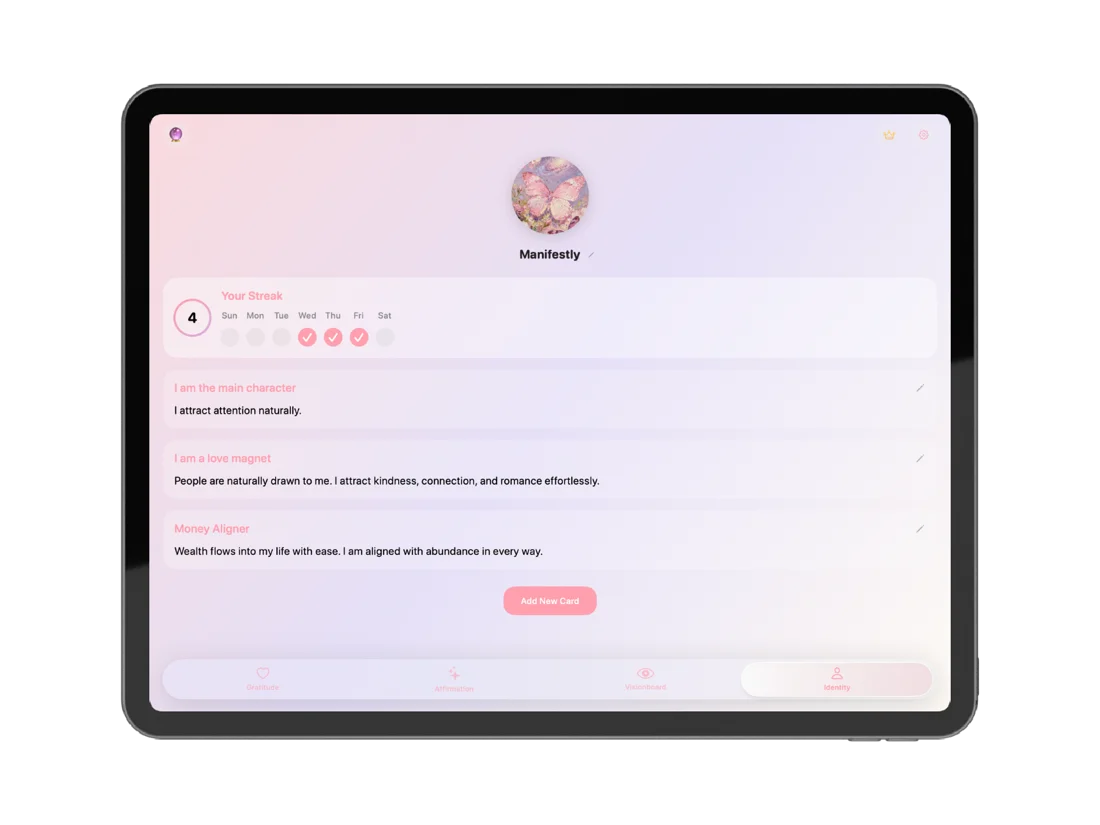
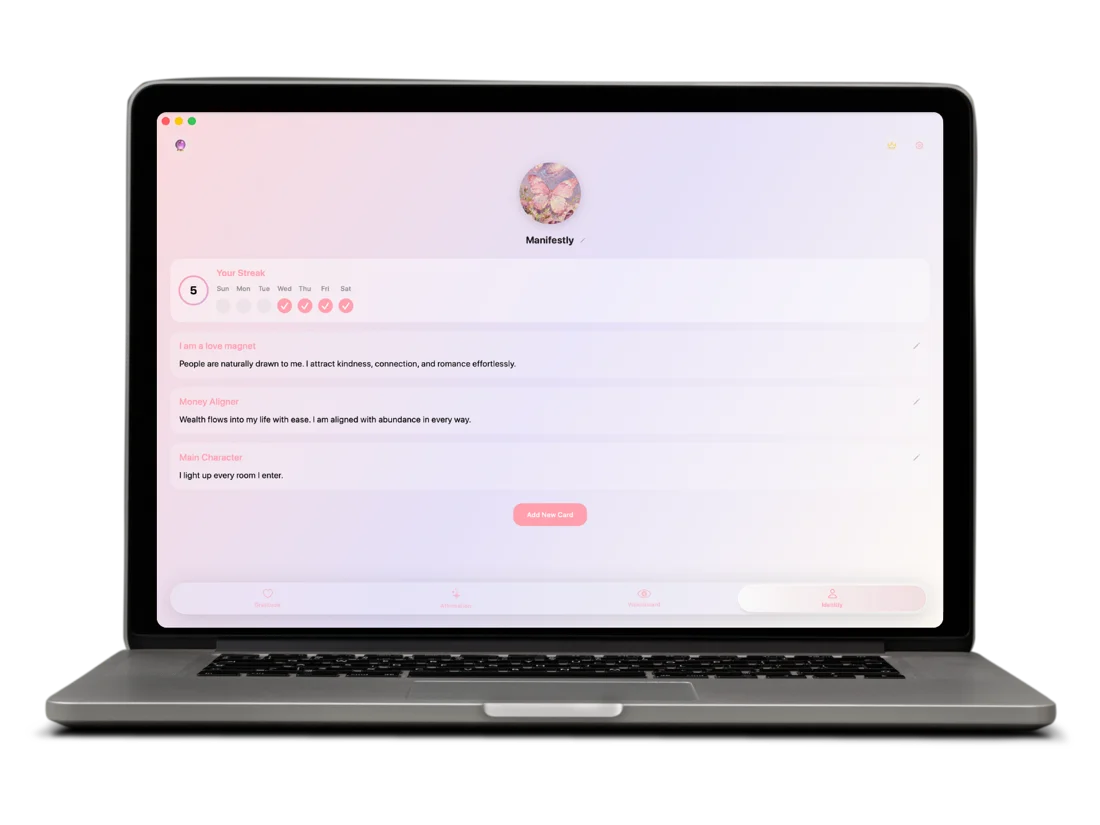
Same cards on iPhone, iPad and Mac — open the one you need in the moment.
“I am someone who finishes what she starts, calmly.”
Read it each morning, then carry the identity into one real choice today.
46 of 90 days to your next review
Many of the stories we carry came from family, school, relationships, or an older version of ourselves. An identity card lets you choose a new self-concept on purpose and begin responding to life as the person you want to become.
Choose the qualities, beliefs, and standards you want to live from instead of accepting an old label as permanent.
The identity becomes real through the email you send, the boundary you hold, and the promise you keep today.
Write from the person you are becoming, even before every part of the outside world reflects the change.
When an identity feels natural, honor the growth and write the next version of your story.
A goal gives you a destination. An identity gives you a way to think, choose, and show up on the way there.
“I will finish the project by December.”
A useful destination, but it does not tell you how to show up when motivation is low.
“I am someone who finishes what she starts, calmly.”
A self-concept you can practice today. Each aligned choice gives the new identity more evidence.
“I am the kind of person who keeps promises to herself.”
“I am someone who handles money with clarity, not panic.”
“I am someone who stops before I am empty.”
Take ten quiet minutes to name your best self, then use a few seconds each morning to remember how that version of you lives.
Look beyond the achievement and ask who naturally creates it. Calm with money. Confident in meetings. Open to love. Kind to yourself after a difficult day.
Use the first person and present tense: “I am…” or a role name that feels meaningful. If the words feel too far away, use “I am becoming…” until the identity feels possible to inhabit.
The title names who you are; the second line shows how that person lives. “I light up every room I enter” might mean “I introduce myself first instead of waiting to be noticed.”
Morning is a natural time to return to the card. You can also read it before a moment that asks you to choose between the old pattern and the person you are becoming.
When the words feel obvious, the identity has become familiar. Celebrate the shift, then write the next expression of your best self.
The board shows the life. The card defines who is living it. Affirmations strengthen the voice, and gratitude reveals the proof.
Let the images show where you are going while the identity card reminds you who belongs in that life.
Repeat thoughts in the voice of your best self until the new self-concept begins to feel natural.
Record the moments when you already acted from the new identity. Evidence helps the story become believable.
An identity card is a short statement you write to define who you choose to be. It includes a title and a line that bring your best self into focus — not the identity other people gave you, but the one you consciously claim and practice.
Goals describe what you want to achieve; identity describes who you are while creating it. “Run a marathon” is a goal. “I am a runner who honors my body and keeps promises to myself” is an identity. When the identity feels natural, aligned choices require less negotiation.
Self-concept is the collection of beliefs you hold about who you are, what you deserve, and what is possible for you. An affirmation is a thought you repeat. An identity card brings those thoughts together into a clear definition of the person you choose to embody.
One or two active cards are usually enough. Keep one card for the version of you you are becoming overall, and add another for an area such as love, money, confidence, or well-being when it needs focused attention.
Read your card in the morning before outside expectations shape the day. You can also open it before a meeting, decision, date, or difficult conversation and ask: how would this version of me show up now?
Yes. The law of assumption teaches that you experience life through what you accept as true about yourself. Identity cards make that idea practical: define the self-concept, read it regularly, and let daily choices become evidence of the new assumption.
Three cards on the free plan, with unlimited edits. Premium removes the limit and adds iCloud sync across your devices.

Write the person you choose to be, return to that identity each day, and begin living as your best self. Free on iPhone and iPad, with Mac coming soon.